So, I’d discovered Santana through the brilliant 1977 album Moonflower. What next?
This was the late 1970s. There was no Spotify, no YouTube and no instant access to an artist’s entire back catalogue. If you discovered somebody you liked, part of the fun was working out where to go next.
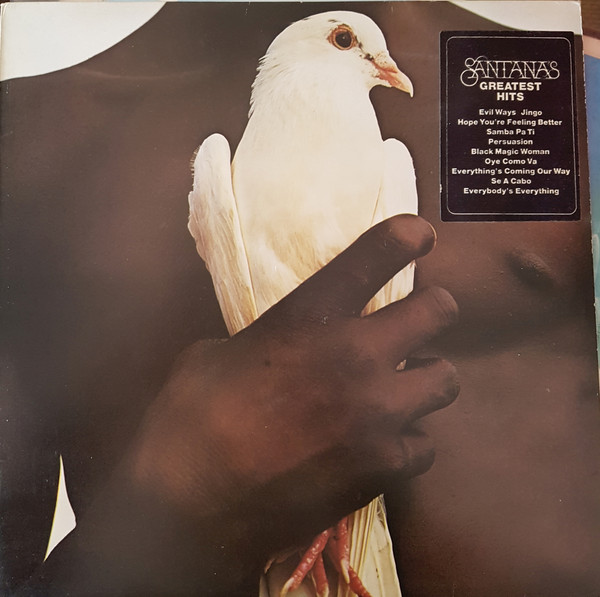
So, I ventured into the record shops of Twickenham, Richmond and Kingston looking for enlightenment. I forget which shop it would have been, but I soon happened upon Santana’s Greatest Hits.
Now, I know. “Greatest Hits” albums!
There was always a certain amount of sniffiness about them among serious rock fans. Proper fans bought the albums. Greatest hits collections were somehow for everyone else.
I’ve never really bought that. There are greatest hits albums and there are greatest hits albums. Fleetwood Mac’s from the Peter Green era was a terrific one. The Eagles’ Their Greatest Hits 1971-1975 was another. Sometimes a really well put together collection isn’t just a convenient bundle of familiar songs — it’s a doorway of discovery into a band.
And Santana’s Greatest Hits was certainly that for me.
The cover alone was striking. A white dove held against the bare chest of a black man. Peace, love, racial harmony; perhaps a nod towards the African roots that run through so much of Santana’s music. Not overtly political, but certainly suggestive of something deeper. Turn the album over and the dove is in flight.
And then there was that track listing.
Evil Ways. Jingo. Samba Pa Ti. Black Magic Woman. Oye Como Va. Se A Cabo. Everybody’s Everything…
Ten tracks, all drawn from Santana’s first three albums, and a remarkably good introduction to what that original band was all about.
If Moonflower had grabbed me, Greatest Hits began to show me where the music had come from. There was the raw, almost primal percussion of Jingo, the blues and rock, the Latin rhythms, the beautiful simplicity of Samba Pa Ti — and, running through it all, that guitar.
Carlos’s sound was unmistakable. Warm, singing, sustained notes and a wonderfully melodic approach to playing. He could certainly play fast when he wanted to, but it was never really about how many notes he could squeeze into a bar. The notes had space to breathe.
For a young guitarist still finding his own way, that made quite an impression.
So did the rhythms. Congas, timbales and percussion weren’t decoration added to a rock band — they were right at the heart of the music. That fusion of blues, rock, Latin and Afro-Latin rhythms sounded unlike almost anything else I was listening to at the time.
And it stuck. Santana’s sound and Carlos’s approach to the guitar became deeply influential on me as a musician. Nearly half a century later, they still are.
Looking back, perhaps it’s no coincidence that so many tracks from this particular record have found their way into Corazon’s repertoire: Black Magic Woman, Oye Como Va, Samba Pa Ti, Evil Ways, Jingo, Everybody’s Everything. I don’t think that’s something I ever consciously planned. These songs have simply become part of my musical furniture.
I honestly can’t remember the last time I sat down and played Santana’s Greatest Hits from beginning to end. Now I’ll make a point of it.
I suspect quite a few people reading this will remember that cover sitting in their own record collection. Maybe you bought it around the same time I did. Maybe it was part of your own introduction to Santana.
And if you’re discovering this music for the first time now?
Don’t be sniffy about the words Greatest Hits.
Turn it up.
It’s still a pretty wonderful place to start.